Showing posts with label dairy-free. Show all posts

Saturday, November 14, 2015

Smitten Kitchen's Warm Potato Salad

The sun is setting at 5 PM now, so getting photos of my dinner that look nice is hard!

When I first saw Smitten Kitchen's recipe for potatoes with soft eggs and bacon vinaigrette, I knew I had to make it immediately, as it was a perfect combination of things that I love (potatoes! bacon! vinaigrette! soft eggs! some greens to make it healthy!) I made it for dinner the next night even though I didn't have all of the right ingredients on hand, and it is such a well-written formula that tweaking it to use slightly different ingredients still yields a delicious warm potato salad.

So! I have made this half a dozen times since Deb posted the recipe, and have figured out that I prefer this meal with poached rather than soft-boiled eggs (I find peeling soft eggs without crushing them to be rather difficult, alas), that it works better with greasier bacon so that there is sufficient bacon grease for the vinaigrette, that it is just fine without blue cheese, and that boxed salad greens work very well when your local grocery doesn't stock frisee.

Though I tend to make a couple ingredient changes from the original, I am just posting this as a recommended recipe, rather than posting a recipe here, because Deb's recipes are always so beautifully done and well-tested. You should make this, it is delicious and gluten-free, and by skipping the cheese it is dairy-free too!

Thursday, August 21, 2014

Coconut Macaroons

I had a bag of unsweetened coconut lurking in the back of my cupboard, and in the spirit of trying to use up ingredients but also wanting something really simple to bake because I cannot deal with recipes that use up dozens of dishes these days, I made some macaroons. I was surprised by how much I liked them; they are slightly crisp on the outside and pleasantly chewy inside.

Macaroons: very simple to make, and gluten-free/dairy-free without adaptation.


Macaroons (with unsweetened coconut)

Adapted from this recipe

As always, if you need to be gluten-free, make sure to check your ingredient labels before baking.

3 egg whites
2 cups finely shredded unsweetened coconut
½ cup plus 1 TBS granulated sugar
1 tsp vanilla extract
¼ tsp sea salt (optional)

Yields about 12 cookies.

Preheat oven to 350 F.

Mix all the ingredients together, until all the coconut is incorporated and the dough is slightly sticky (you may need to use a little more or less coconut depending on how big your egg whites are).

Cover a baking sheet with parchment paper (or use a lot of cooking spray instead of the paper, but I like parchment paper because it makes clean up really easy). Using your hands or a spoon, form the dough into walnut-sized balls and place on the baking sheet. Flatten them slightly.

Bake at 350 F for 16-20 minutes, until the macaroons are slightly brown (I live at 7000+ feet, you may need to adjust your cooking time. 18 minutes was perfect for these cookies at my altitude).


 Mixing all the ingredients together.

It will take a few minutes of stirring, but eventually all the ingredients will come together to form a dough. 

Unbaked macaroons. 

Baked macaroons! You can see that I had a small ring of caramelized sugar/egg white around the macaroons. I think this could be prevented by adding a little more coconut and/or by putting the cookies on the middle over rack; I forgot to rearrange my oven racks and used the bottom one.

Sunday, May 5, 2013

Olive focaccia from gluten-free pizza crust mix


I have been absent from this blog for an entire school year. I had intended to write a post over Christmas break, but then my computer broke and I didn't get it back from the repair place until well after classes had started back up (which was stressful when trying to write a presentation). As it turns out, grad school is hard, and it takes enough time as it is just trying to make nutritious food, let alone blogging about it. Classes are done for the year, though! I just need to get through a final and a qualifying exam, then I will officially be in the program and on my way to getting my PhD. I am excited while also being mildly terrified.

Most weeks there hasn't been a lot of time for baking, and certainly not much time for tinkering with new techniques and recipes. I have looked at this recipe by the Gluten Free Goddess with the intent to make it, but I haven't yet just because of time. Inspired by how delicious it looks, I saw that I had a bunch of pizza crust mixes in my cupboard and decided to experiment. I am very happy with this olive focaccia recipe, both because it is absurdly delicious, and because it is so very easy! I made this in 1.5 hours, and about 1.25 of that was rising and baking. That fits into my (incredibly busy) schedule quite nicely. (No, seriously, some well-meaning ladies at church were telling me that I am just finding excuses to get stressed, and I responded with how excited I am to join my thesis lab, because for most of the summer I will only be working 60 hours a week thanks to no classes and it will be relaxing. They were like "...oh.")

The trick to this is that I used Bob's Red Mill gluten-free pizza crust mix, which makes really good focaccia-style bread, as it turns out. And I accidentally bought four of the crust mixes for about 3 dollars a piece (long story) on Amazon the other day, so this was quite a bit cheaper then some of the 6 dollar GF bread mixes I've used.


 So here is how to make it:

Olive Focaccia from GF pizza crust mix.

Ingredients:

1 package Bob's Red Mill pizza crust mix (you could probably use another brand, but I wouldn't know what is good)
1.5 cups warm water
2 eggs
2 Tbs olive oil, plus more for the pan and the loaf.
30 or so of your favorite olives (pitted!)
Sea salt to taste
Rosmary or other herbs to taste

Mix the warm water (110 F) with the yeast packet from the mix in a large bowl. Let the mixture sit for five minutes, this is "proofing" the yeast.

Add eggs and 2 Tbs of oil, and whisk together. Add the contents of the pizza mix and stir until the dough is well-mixed.

Let the dough rise for 20-30 minutes.

Preheat oven to 400 F.

Oil a 9 inch round cake pan well with olive oil. Transfer the dough from the bowl to the pan, then pour another tablespoon or two of olive oil over the top of the dough, which is both delicious and will also help you during the next step.

Smooth the surface of the dough with your hands so that there is a fairly level surface. The olive oil helps keep your hands from sticking.

Make sure that your olives are fairly well-drained before proceeding.

Push pitted olives into the surface of the dough, making sure they are well-buried, but the tops are still visible. I used a mix of smoked green olives and kalamata olives. Be sure to space the olives apart fairly well.

Sprinkle the top with sea salt. Rosemary or Italian seasoning would have been excellent, but I didn't think of it in time.

Allow the bread to rise for another 10-20 minutes while the oven is heating.

Bake the bread for 25-35 minutes (I only needed 30, but I am baking at 7200 feet and you may need more or less time). The surface of the bread should be lightly brown, and if a fork or toothpick is inserted into the bread, it should come out clean.

Let the bread cool for 20 minutes or so, then slice and enjoy!


If you can't have one of the ingredients in the mix, or don't want to buy a mix, then check out the Gluten-Free Goddess's recipe. I have not made it yet, but it was the inspiration for this!

Sunday, June 10, 2012

Baking Powder Biscuits, gluten-free and vegan


I have been a bit remiss in blogging. It may have something to do with the fact that we have been going places like this:

Crater Lake, which is still very snowy in June. And cold.

Or doing things like this:


Cannon Beach! You can rent a bike and drive on the beach and it is fun! Also, this was the first time I'd been on a bike in years.

...every weekend. The Man and I have been taking a somewhat whirl-wind tour of Things We Love or Have Always Wanted to Do in Oregon Before the Epic Wyoming Move. So of course that means visiting the coast and as many of the national parks as we can get to before moving day arrives.

While eating breakfast on one of these weekend trips, The Man and I both found ourselves lamenting that there isn't much in the way of gluten-free breakfasts to be had at restaurants (he can eat gluten, but often feels sad for me that I can't just order pancakes when we go out). Usually you can have some kind of omelet or potatoes at a restaurant, but we both were thinking how nice it would be to have a good GF biscuit recipe that either of us could just whip up at home.

That got me thinking about weekend breakfasts at my house growing up. My Dad would always (and still does!) make breakfast on Sunday morning. He'd get up at what seemed an early time to me (but I often get up at 5 for my job now, so seven is sleeping in. I must finally be a “real” adult.) and start making eggs and coffee. And there were almost always biscuits. It was a pretty simple recipe, half bisquick, half whole-wheat flour, and all of the add-ins that the bisquick box said to do. I have fond memories of being eight or so, and learning how to shape the biscuits. We don't cut and roll biscuits in my family of origin, you take a wad of dough, roll it into a ball, and stick it on the cookie sheet. They were very, very tasty. In eighth grade, I started making baking powder biscuits from scratch so often that I had the recipe memorized for a while.

Biscuit dough is so simple, surely it must be easy to make gluten-free, I thought. So I took a look in an Amish cookbook I have, and made a couple ingredient swaps to take out dairy and gluten. The result? Tasty, fluffy biscuits that the Man and I happily ate for lunch. They don't quite taste as whole-grain as the biscuits my Dad makes, nor as light as the white-flour ones I used to make, but they are a happy compromise, without the gluten and dairy.

Baking Powder Biscuits
Adapted from “From Amish and Mennonite Kitchens,” by Phyllis Pellman Good and Rachel Thomas Pellman

1 cup coconut or alternate milk of choice
2 tsp lemon juice
2 cups gluten-free flour mix*
2 tsp baking powder
½ tsp xanthan gum
¼ tsp sea salt
3 Tbs Shortening (I used Spectrum)


Preheat oven to 450. Combine the milk with the lemon juice, and set aside for at least five minutes**. Meanwhile, whisk together the dry ingredients. This helps make sure the ingredients are evenly distributed. Add the shortening, and blend with a fork or pastry blender until the mixture becomes fine (1/3 inch or less) crumbs. Add the milk-lemon juice mixture about a quarter cup at a time, stirring the dough after each addition. The dough should be slightly wet, so that it clumps together, but not as wet as muffin batter.

Take about 2 tablespoon of dough at a time, roll into a ball with your hands, and press onto a cookie sheet. Flatten the ball slightly. Do this until you have used up all of the dough. Alternatively, roll out the dough to ½ inch and cut biscuits out.

Bake for 10 to 12 minutes, until lightly browned. Makes about 10 biscuits.

Yaaaaay!


They were a little more crumbly then normal wheat biscuits, but still held up well to normal toppings like jam.

Incidentally, it has been just over one year since I got my gluten-intolerant diagnosis. I thought about doing some kind of big dramatic blog about it, but I haven't the extra time between my job and getting ready to move. I just wanted to make a note of it, and encourage any people who are newly gluten-free. The adjustment does suck a lot at the beginning, but after a year of this diet, I feel so much better, and it is pretty easy and natural to cook for myself. Hurrah for better health!


* My current favorite flour mix is 2 parts sorghum flour : 1 part millet flour : 1 part brown rice. I keep it in a big container. I think this would work well with part oat, or quinoa, or oat flour, but to make biscuits exactly like these, use 1 cup sorghum, ½ cup millet, and ½ cup brown rice flours.

** Adding lemon juice to milk (either an alternate milk or a dairy milk) makes a sort of cheaters buttermilk. Do this anytime you need a non-dairy buttermilk in a recipe, or if you can have dairy, but don't feel like running to the store just for buttermilk.


Sunday, February 12, 2012

Molten Chocolate Lava Cake, Gluten Free

You can see here why it is called "molten" and "lava" since a little batter spills out of the finished cake.

We don't typically do a lot to celebrate Valentine's Day at my household. It can be a fun holiday, if you are seeing someone; but it can be painful if you are single, or a hassle if you're not, or both either way. I suppose it just seems strange when a holiday insists that you must be romantic in a certain way on a certain day, especially a holiday named for a Roman martyr. Valentine's Day is nice excuse for chocolate and a date night, though.

Which was part of the inspiration for making a gluten-free chocolate lava cake. I keep seeing glutenous chocolate recipes everywhere on the Internet because it is February. I used to make this recipe a fair bit, because it is quick, easy, and delicious, yet seems quite fancy. So I adapted it to be gluten-free. It can also be made totally dairy-free if you use coconut oil instead of butter. Both are delicious.

This is a pretty fantastic dessert, and just in time for Valentine's Day, whether you celebrate it or not!

Molten Chocolate Lava Cake, Gluten Free

Adapted from Brandielle's recipe

Also, the Pioneer Woman made the original recipe with a bunch of step-by-step photos a few years ago, if you are so inclined.

Serves 2 (can easily double or triple)

4 ounces dark chocolate
¼ cup butter or coconut oil (½ a stick)
½ cup powdered sugar
½ cup gf flour, such as sorghum
2 eggs
1 tsp vanilla

Preheat oven to 425 F.

Melt the chocolate and butter together by microwaving in a microwave-safe bowl in 20 second increments. Stir between microwaving, until the contents of the bowl are completely melted. Allow the mixture to cool for 3-5 minutes.

Add the sugar, flour, eggs, and vanilla, and whisk until the mixture is smooth. Spoon the batter into two well-greased ramekins. Bake for 13-14 minutes, or until soft in the middle, but not liquid.

Remove the ramekins from the oven, and let cool for a few minutes. Invert the ramekins onto a plate. The cake should have a bit of gooey batter in the middle, hence the “molten” and “lava” in the title. Eat and enjoy!


Stirring the melted chocolate and butter/coconut oil

Stirring in the flour, sugar, vanilla, and eggs. It is important to let the chocolate cool off a bit before adding in the eggs, so that they don't congeal or cook.

The batter prior to baking.

After baking.

Inverted.

Delicious chocolate middle! It is like having chocolate sauce on your cake, but without the extra work.

Sunday, January 29, 2012

Delicious Chocolate and Blood Orange Cupcakes

(Which I was going to call “Gluten-free vegan chocolate cupcakes with a customization option which I made with blood oranges” but I realized that this was a rather long-winded way of titling something which, quite simply, was delicious).


These pictures are not the greatest; I was in a hurry to finish baking before a meeting.

A lot of people in my life have food allergies/intolerances now, and so it is pretty common to have long email threads before a gathering to see who can eat what, and what people should bring that everyone can eat. This is very confusing for folks who do not live with these dietary issues, particularly when it comes to baking. So, usually I am asked to handle the desert. Which I am happy to do!

Most recently, we needed to accommodate egg, dairy, and gluten issues, so the brownies that I normally make were out. I had made these mocha cupcakes before, and they were delicious, but there were young kids at the gathering, and I didn't think their parents would appreciate a caffeine-laden desert. But I liked the idea of cupcakes (according to The Internet, cupcakes are a culinary trend that is becoming unfashionable) (I think that is ridiculous, cupcakes have always been a mainstay of birthday parties and gatherings where a layer cake is impractical) (plus they are super-kid friendly and seem to make a bit less of a mess) (good heavens this is a lot of parentheticals) so I tweaked the already-fabulous recipe into something that would work for me.

And thus we have this recipe for a plain chocolate cupcake, which is also vegan and gluten-free.

Chocolate cupcakes

Adapted from the Gluten-Free Goddess

Dry ingredients

¾ cup sorghum or brown rice flour
¾ cup cornstarch
½ cup cocoa powder
1 cup granulated sugar
½ rounded tsp sea salt
1 tsp baking soda
1 tsp baking powder
1 tsp xanthan gum

Other ingredients
2 Tbs ground flax seed + 4 Tbs warm water (you can use 2 eggs instead if you prefer)
1 cup non-dairy milk of choice
3 Tbs light-tasting oil
½ tsp vinegar
1 tsp vanilla extract

Preheat oven to 350 F.

Combine the flax with the warm water in a small bowl, and set aside, allowing it to sit for at least five minutes. This is your “egg.”

Combine the dry ingredients in a medium sized bowl, and whisk together to incorporate.

Add in the other ingredients, including the flax “egg,” and mix for 2-3 minutes. This can be done in a stand mixer or with a regular spoon or whisk if you don't mind a work-out. The batter will be very thick, and somewhat stringy.

Fill muffin tins (lined with cupcake liners) about 2/3 full of batter. It may be necessary to smooth out the tops of each tin of batter with the back of a spoon in order to get a smooth top after baking.

Bake cupcakes for 20 minutes.

Makes 1 dozen cupcakes.

Remove from the tin to a wire rack to cool, or else the cupcakes become slightly soggy.

Wait until the cupcakes have completely cooled prior to frosting.

Frosting:

2 cups powdered sugar
2-4 Tbs shortening (I used Spectrum)
¼ cup cocoa powder
1 tsp vanilla extract
2-3 Tbs non-dairy milk

Combine the first four ingredients, then add “milk” one tablespoon at a time. Blend with a stand or hand mixer until fluffy. Add more liquid if necessary. Pipe or spread onto cooled cupcakes.

Unfrosted chocolate cupcakes. Gluten-free baked goods are often a little lumpy if you don't smooth out the batter.

Variation:

After making these, I decided to try to make another variety. I suspect you could make infinite variations to this recipe if you so desired. Basically, you change what spices or extracts you add to the batter, replace cocoa powder with cornstarch if the cupcake is non-chocolate, and use different liquids for the “milk.” I made a blood orange cupcake, and it was fantastic. I used these ingredients, following the instructions above. Please experiment with making your own changes to the recipe, until you find something that you really like! The recipe seems to be pretty forgiving.

Blood orange cupcake variation

Dry ingredients

¾ cup sorghum flour
1 ¼ cup cornstarch
1 cup sugar
½ rounded tsp sea salt
1 tsp baking soda
1 tsp baking powder
1 tsp xanthan gum
half the zest of a blood orange
½ tsp nutmeg

2 Tbs flax + 4 Tbs warm water
3 Tbs oil
½ cup blood orange juice
½ cup coconut milk
2 tsp lemon juice

Frosting:

2 cups powdered sugar
2-4 Tbs shortening
half the zest of a blood orange
~2 Tbs blood orange juice


Unfrosted cupcakes. These were pretty tasty plain.

Pretty pink frosting.


So try either variation, or play with the ingredients and make your own! Cupcakes should be fun as well as tasty.


Sunday, January 15, 2012

A Gluten-Free Twist on Eggs Benedict


One thing I miss quite a bit since going gluten-free is Eggs Benedict. It is a delicious dish, but in my mind it is dependent on having a perfect English muffin. I have not found a DF/GF English muffin yet that works for me, and I haven't gotten around to making my own yet. I am still working on a bread replacement that tastes like real bread (my recipe on this site is tasty enough, and good for putting sandwich fillings on, but the texture is all wrong when I crave real bread) after all. So I decided to put together a deconstructed Eggs Benedict since I had Canadian bacon in the fridge. Then I thought I'd add salsa and avocado. I needed some carbohydrate to hold it all together, so I made brown rice.

The result was more of a Southwestern-inspired meal, and is nothing like Eggs Benedict aside from the egg and canadian bacon, but it was good.

To make your own, first start cooking some brown rice. When it is done, fry a slice or two of canadian bacon. Meanwhile, spoon some rice onto a plate. When the bacon is done, place it on top of the rice. Fry or poach an egg until it is soft in the middle. Or until runny, if that is what you prefer. Slide the egg onto the bacon, and spoon salsa over the whole thing. Add avocado slices if desired. Hollendaise sauce would be awesome, but I didn't want to get that many dishes dirty. Put some salad greens on your plate if you are trying to eat better.

Result: tasty, and naturally gluten and dairy free.


Sunday, December 18, 2011

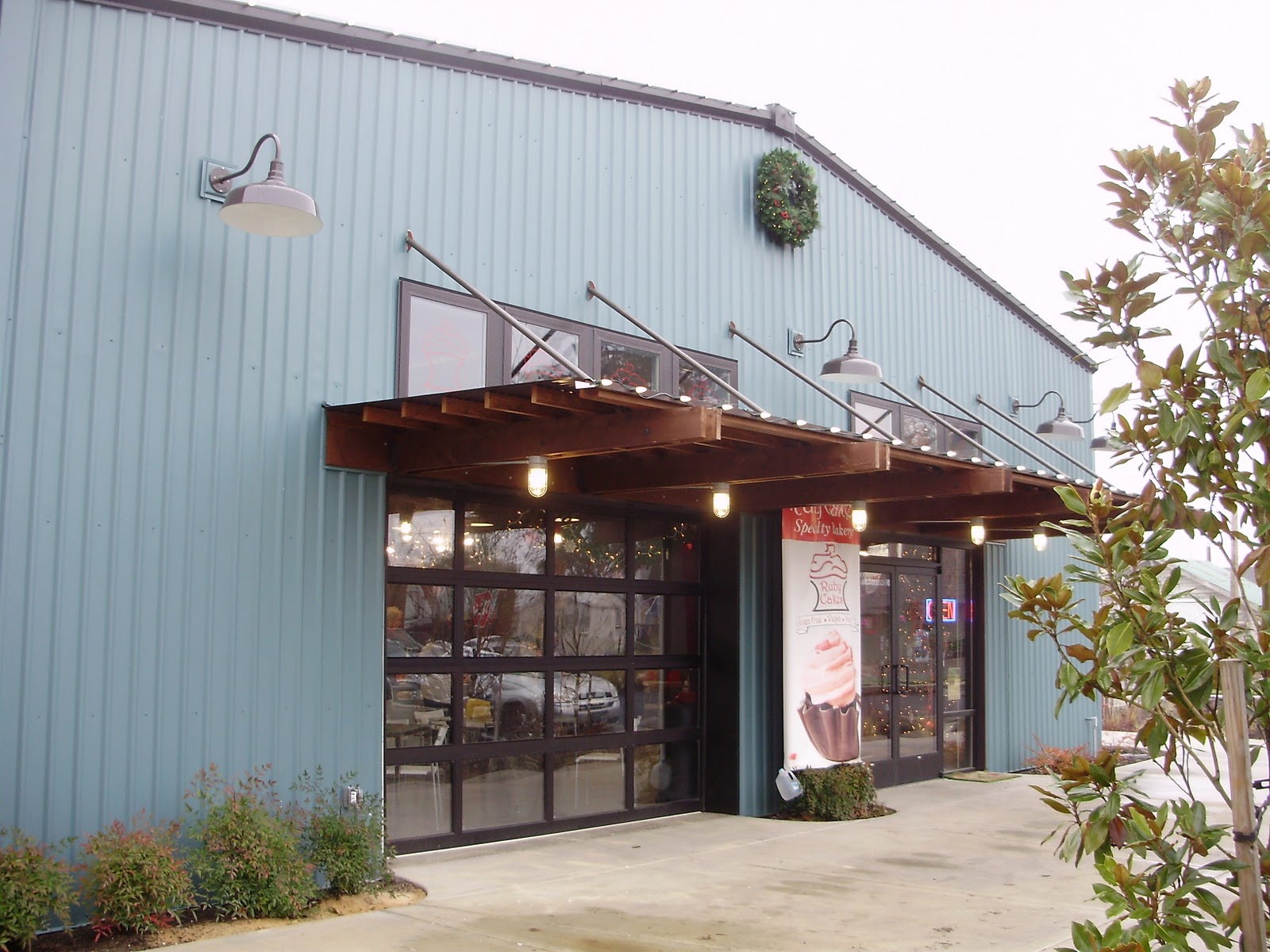
Ruby Cakes Review

Dear readers who don't live in Oregon: feel free to skip this post, as it is about a local business.


This weekend, The Man and I tried out a new bakery in the area. That sounds a bit mundane, until it is pointed out that the bakery mentioned is a dedicated gluten-free, nut-free, vegan place. “Wait, so I can eat every single thing?” was my reaction when I first heard that this place was opening.

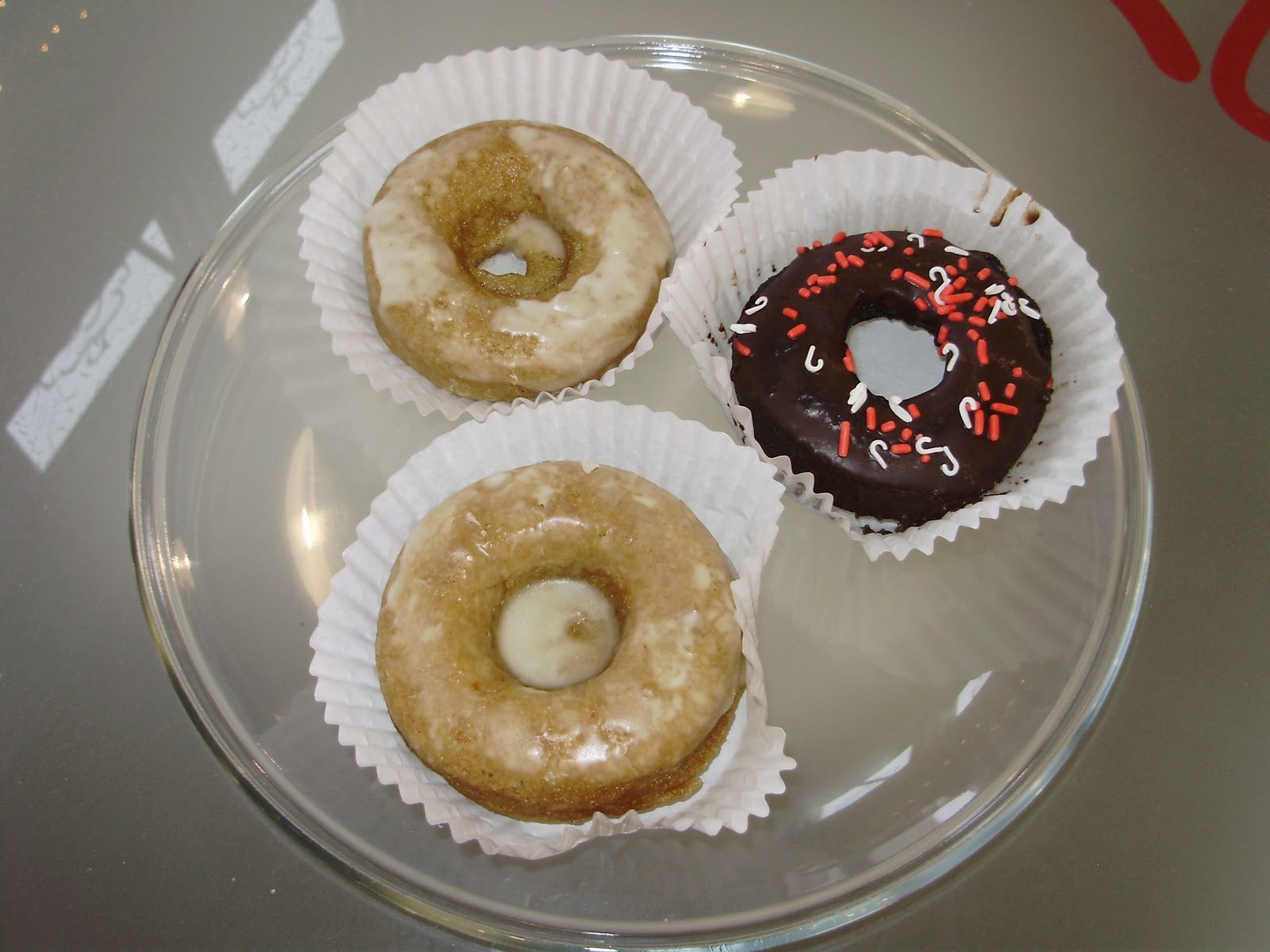
Ruby Cakes in McMinnville was a fantastic experience. They had quite a variety of baked goods, and each thing that we tried was amazing. Moreover, there was something wonderful about knowing that the treats were perfectly safe for my food intolerances, as well as many other people in my life. The staff were friendly and knowledgeable, and genuinely interested in providing the community with allergen-free treats. I was also pleased that the prices were quite reasonable; comparable to what I have paid for things at glutenous bakeries.


 These little doughnuts were delicious.

This cinnamon roll was huge; I split it with The Man. I never expected to be eating a cream-cheese frosted cinnamon roll again, and I could not tell that it was vegan or GF! Saturdays are cinnamon roll day at the bakery.

There were 8 kinds of "milk" for the coffee, only two of which contained any dairy. This was fantastic!

I am very happy that this business has opened, and I will most assuredly be visiting again in the near future. If you live near McMinnville you should try this place, even if you don't have any allergies.  


Wednesday, December 14, 2011

Red Curry

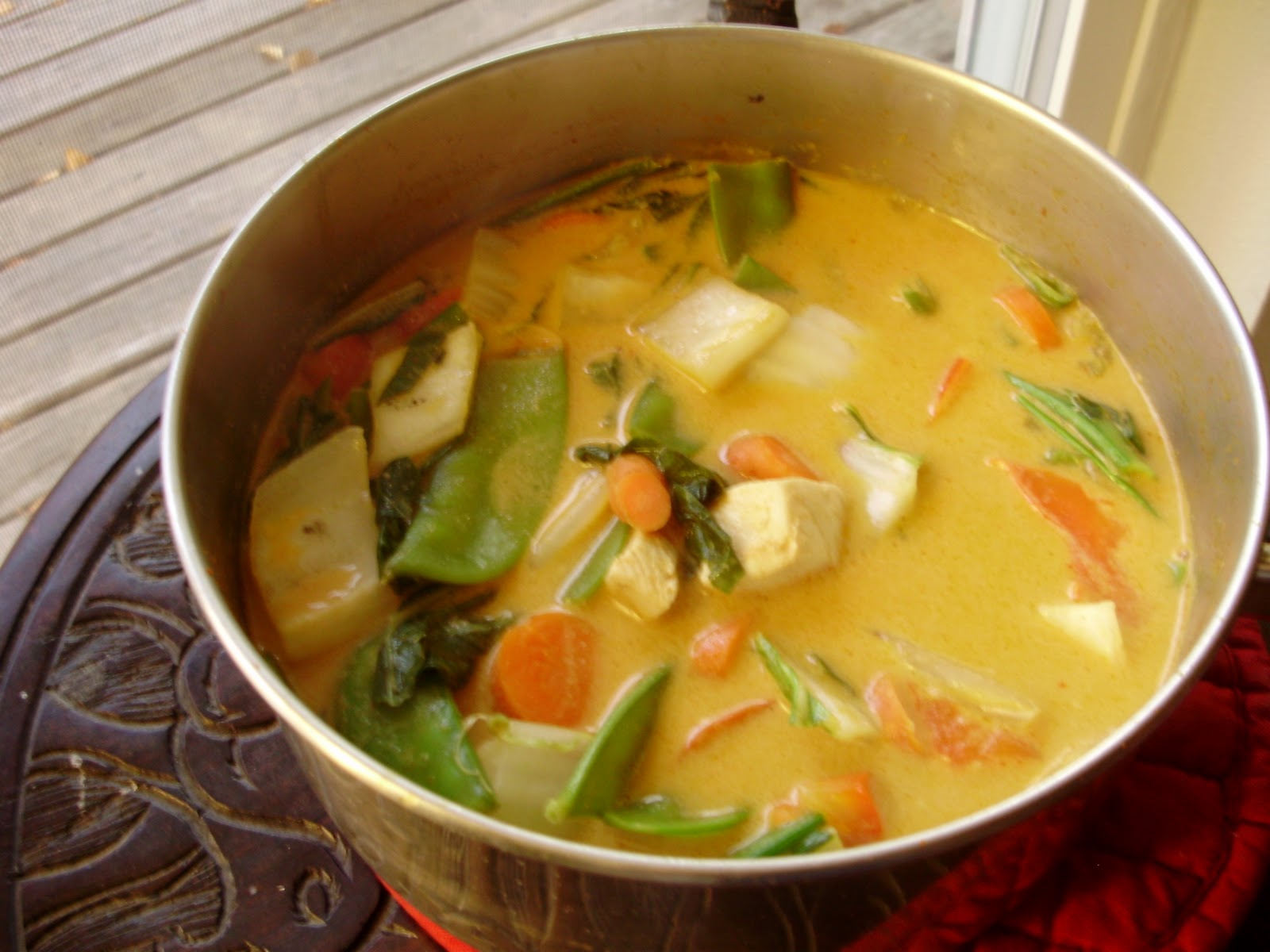
Delicious curry. Also, that table is from South Africa, which does not pertain to the Thai food. I just like the table.

Even before my GF-DF days, I really loved Thai food. I love that distinct flavor-profile of ginger, basil, lemon-grass and coconut; the mixture of savory and sweet. I have enjoyed Pad Thai and curries for a long time, perhaps influenced by the fact that my family lived in Bangkok for a while, (before I was born) and my parents used to take us out to Thai food. Now, though, I like this cuisine even better, because Thai-food places are generally already gluten and dairy-free. At the restaurant I go to, they even make my iced tea without the condensed milk in it.

I don't always feel like going out to eat in order to get my fix, though, so sometimes I make curries at home. They never seem to be as good as what you get at a restaurant, though, and I decided that maybe this was partially because I never actually follow a recipe with this kind of thing. So here is what I made for dinner recently (I can't only post recipes for baked goods, can I?) adapted from this recipe by Thai Kitchen. I tend to use a lot of their products anyway, because they are clearly labeled gluten-free. Disclaimer: Thai Kitchen doesn't know who I am, I just like their stuff.

Red Curry

1 Tbs vegetable oil
1 Tbs of GF red curry paste
1 can of coconut milk
1/2 cup chicken or beef broth
1 tsp brown sugar
1 ½ tsp GF soy sauce or fish sauce
½ tsp sirracha sauce (optional, adds some heat)

½ pound of chicken or beef, cut into ~1/2 inch pieces
½ large or 1 small red pepper, chopped into ~1/2 inch pieces
2 carrots, cut into diagonal slices
1 cup snow peas, cut in half
1 small bunch of bok choy or napa cabbage, cut into ~1 inch squares
other options: onion, Thai or regular eggplant, bamboo shoots, baby corn, whatever vegetables you like!


 Cut the meat and vegetables into the sizes indicated above, and set aside.

A whole pile of vegetables. You can make substitutions using vegetables that you like and have on hand. 

This was probably more like 1/3 pound of chicken.


Heat the oil over medium in a medium-sized stock pot. Stir the curry paste into the pan and heat for about a minute. Add the broth and coconut milk, then bring to a simmer, increasing heat to medium-high. Add the sugar and soy sauce, and stir well.


Stirring the curry paste into the hot oil. It splatters a little bit.

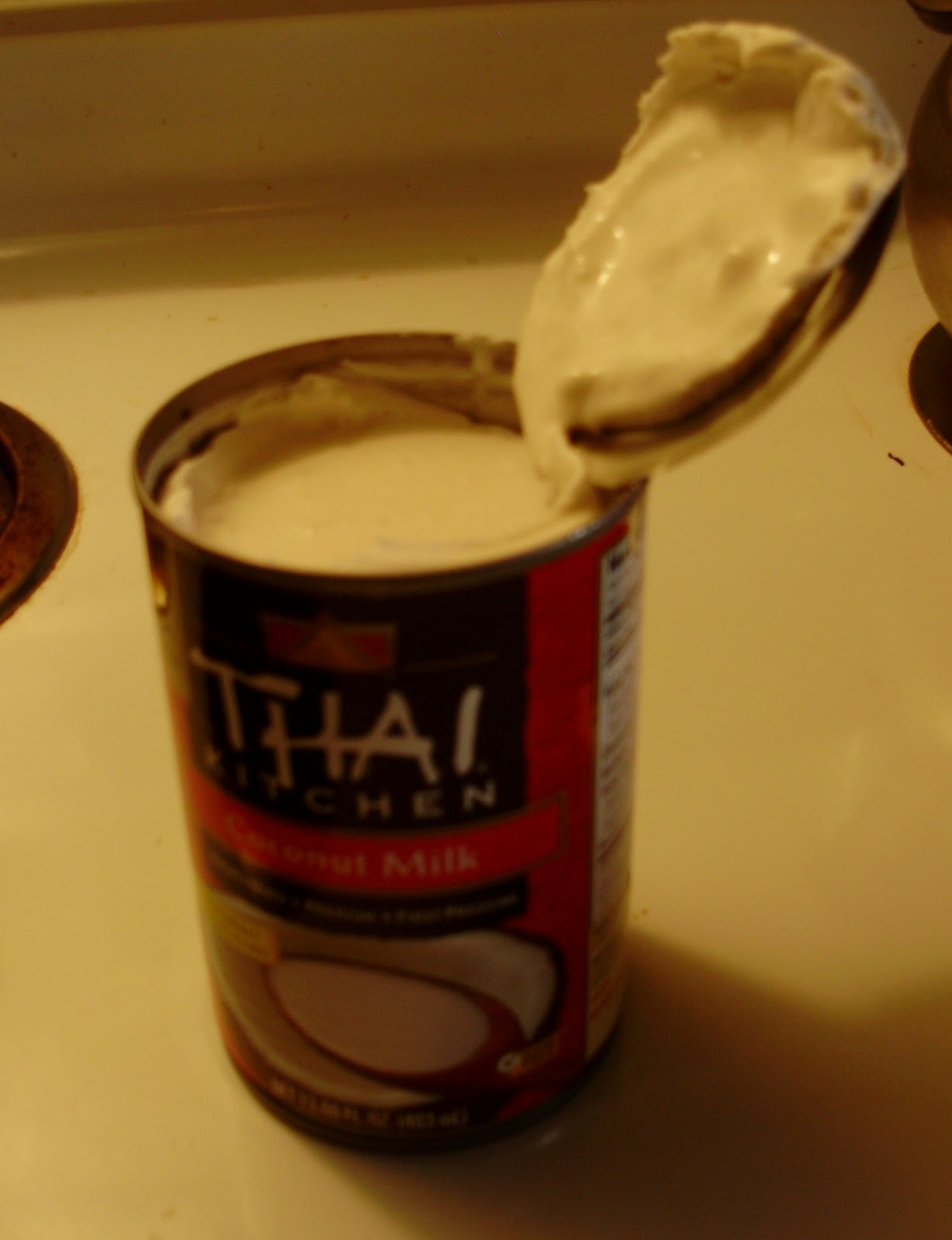
Coconut milk is amazing. If you want this to be lower calorie, you can use the lite milk, or even the coconut milk that comes in a carton. It will not be as rich, though.

Add the milk and broth. It looks a bit low here because at first I had only half of the can in the pot. Later I added the other half.


Add the meat and vegetables to the sauce, and stir periodically. The curry is done when the meat is cooked through, about 7-8 minutes of simmering.  


The pot was a little crowded.

The vegetables cook down after a few minutes.

Finished curry! Put it over rice and you have a good dinner.

Serve over rice or rice noodles. Serves 3-4.

Next time I will probably add in some basil leaves, but otherwise I really liked this!

Saturday, December 3, 2011

Pumpkin bread, gluten, dairy, sugar-free


 Yesterday was my six-month anniversary of going gluten-free. On June 2, I got a phone-call from my doctor, going over the results of some bloodwork, and was told I should stop eating gluten as soon as possible. I resolved myself to a life without gluten, and hopefully some relief from almost-daily joint pain, which on a bad day made it hard even to walk across campus. Now, months later, I have learned a lot and feel amazing compared to where I was in June. Like, I can go on hikes and don't need to spend two days recovering. I have more than two hours of energy each day. Not all of my symptoms are gone, but I am very happy with where I am at compared to just a few months ago. Cooking gluten-free still isn't intuitive, but I think I have gotten a lot better at it. There are very few things the Man has deemed inedible, anyway. So in conclusion, life is pretty awesome right now.

But gluten isn't the whole story. I am dairy-free now too, and I was a lot less dignified when I found that out in July. There were tears, and anger. Now, though, when someone finds out that I am gluten and dairy-intolerant, the reaction tends to be “That sucks, what do you eat?” I am happy to say that there is a lot I can eat. I just have to be a little more creative now. Creativity was part of what inspired this bread recipe.

This particular bread was my response to trying to accommodate a family member with a more limited diet then myself, so that she could eat some bread at our Thanksgiving gathering. There are a lot of good reasons to limit one's sugar intake, and if you make this using the stevia as a sweetener, then the only sugar in the bread is the little bit naturally in the pumpkin. When stevia-sweetened, the bread is almost savory. With the agave or honey, it is only slightly sweet. I enjoyed it both ways.

Pumpkin Bread

Gluten, dairy, and sugar-free

2 Tbs ground flax seed
3 Tbs near-boiling water

15 oz pumpkin puree
2 eggs
3 Tbs agave nectar or honey (see below for stevia substitution)
2 Tbs vegetable oil (or olive oil or melted butter)
2 tsp apple cider vinegar

1 cup almond flour
½ cup brown rice or sorghum flour
½ cup buckwheat flour
½ tsp salt
½ tsp ginger
¾ tsp cinnamon
¼ tsp nutmeg
2 tsp baking powder
1 tsp baking powder

Preheat oven to 350 F. In a large glass bowl, mix together the flax and hot water until they form a paste. Allow it to sit for a minute or two.


Flax seed paste replaces the need for xanthan gum, and adds structure to the bread.


Add in the pumpkin, eggs, agave, oil, and vinegar, and whisk together with an electric beater for a minute.  


Wet ingredients together. I know this is a whisk and not an electric beater; using the latter helps the bread rise more. A whisk works, though!

 Add the flours, salt, spices, baking soda and baking powder and stir together. The batter should be like somewhat fluffy muffin batter. Add a little extra water if needed.

Finished batter 


Grease a baking pan (or line with parchment paper) and pour the batter into the pan. Bake for 40-45 minutes, and allow the bread to cool before slicing, otherwise it will crumble.


Modifications: if you have a nut allergy, the almond flour can be replaced by another flour like sorghum or quinoa. An extra teaspoon or two of oil may be needed, though, as almond flour has a lot of fat in it.

To make this truly sugar free, replace the agave with two or three teaspoons of steavia powder, and add an extra egg white in with the wet ingredients.


Saturday, November 19, 2011

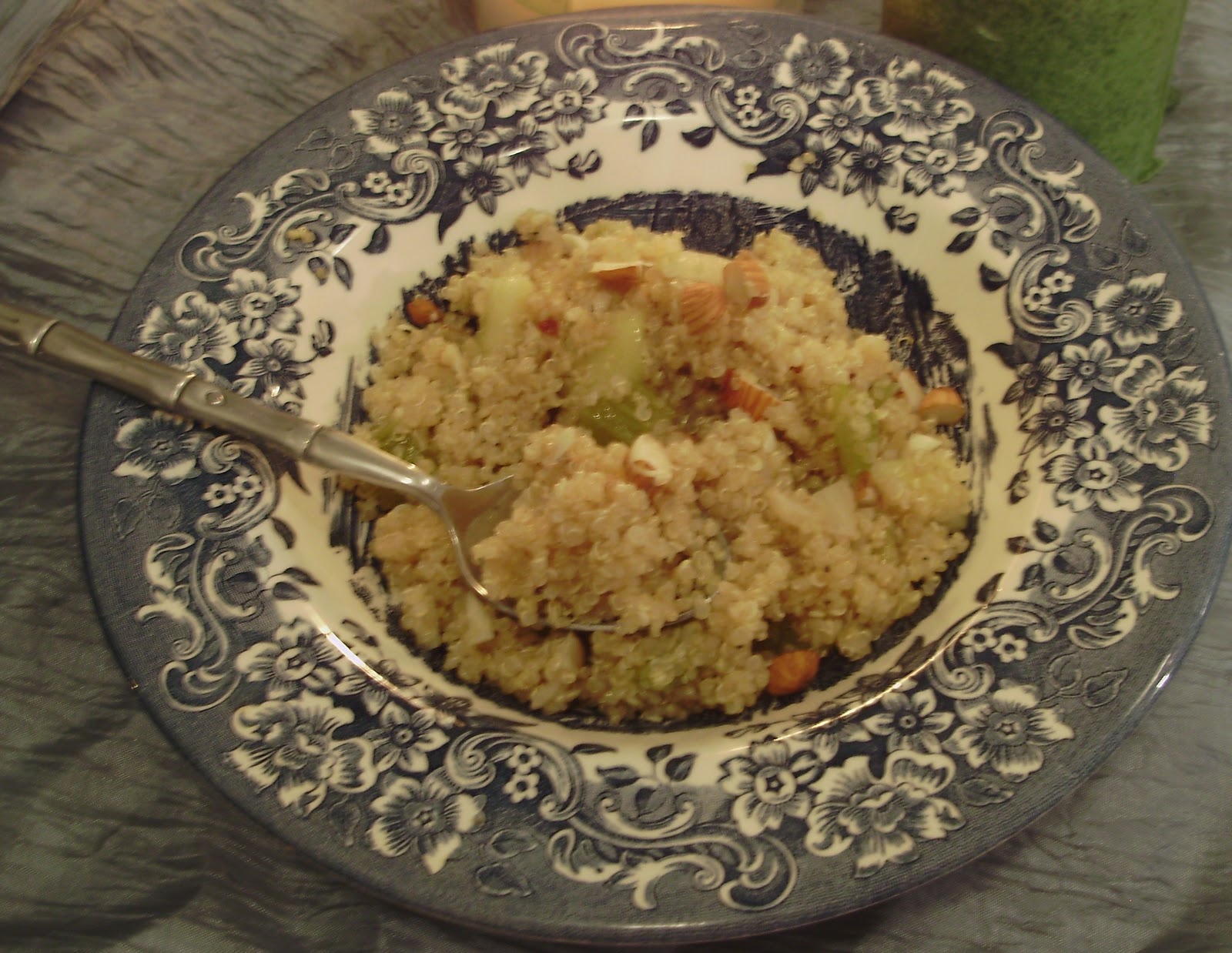
Quinoa Tabouli


Here is a dish which can be the main part of a meal or a side dish, and it is friendly to most of the special diets. It is gluten-free, dairy-free, sugar-free, vegan, can be made nut-free by skipping the garnish, and it has lots of vegetables. Basically, it is awesome. And good for you.

Quinoa Tabouli 

Adapted from this recipe

1 cup quinoa
2 cups water or broth
1/2 of a yellow onion, diced
1-2 cloves garlic, minced
1 stalk of celery, diced
1 half of a cucumber, peeled, seeded, and chopped
1/4 cup lemon juice
3 Tbs olive oil
1 1/2 tsp Italian seasoning
1 1/2 tsp dried oregano or basil
salt and pepper to taste

chopped almonds to garnish, if desired

Rinse the quinoa in a sieve for a minute. This gets rid of the bitter taste from the quinoa. Put the quinoa and water or broth in a pan, and bring to a boil. Reduce heat and cook until the quinoa is done, about twenty minutes. 

Meanwhile, chop and peel vegetables as required. If you do not like the flavor of raw onion, sautee it in olive oil over medium heat for ~5 minutes, I did. 

When the quinoa is done, mix in the vegetables, oil, lemon juice and spices. Garnish with nuts if you so desire.

Serves four.

If I'd had fresh mint or basil and tomatoes I totally would have added them! It is good warm or cold. 


Tuesday, November 15, 2011

Basic Gluten-Free Scones


I don't have a pithy anecdote for this week's post. I've been spending the last couple weeks writing and editing personal statement essays for grad school. Using a day to write "I am an awesome candidate and here is why you should pick me!" is rather draining. All I want to do now is sit in a window seat and eat scones and drink tea. I don't have a window seat, but I did make some scones. nice, simple scones that can be customized however you like. They don't even need xanthan gum.

They are very tasty.

Here is the recipe.

Basic Gluten-Free Scones 

Adapted from King Arthur Flour (recipe here)

Dry ingredients
¼ cup brown rice flour (30 g)
¼ cup potato flour (40 g)
½ cup sorghum flour (65 g)
1/8 cup brown sugar (20 g)
edit: 1 tsp baking powder (can't believe I forgot that!)
¼ tsp salt
½ tsp cinnamon
¼ tsp ginger

4 Tbs butter (½ stick)

up to ½ cup of add-ins (dried fruit, nuts, oats, chocolate chips, coconut etc.)

1 egg
¼ cup milk of choice (I used coconut, use whatever you like and aren't allergic to)
½ tsp vanilla

sugar to sprinkle on top (optional)

Preheat oven to 400 degrees F

Whisk together the dry ingredients in a bowl to incorporate flours. Add the butter; use a pastry blender until the pieces of butter in the dough are the size of peas or a little smaller. Stir in your add-ins at this point, if desired.

In another bowl, mix together the egg, milk, and vanilla. Pour this mixture into the dough, and stir until the mixture forms a slightly wet dough that holds together.

For smaller scones (as in the photographs) take about a quarter cup of dough and shape it into a ball, flattening it slightly onto the cookie sheet. If desired, sprinkle some sugar of top of each scone.

Bake for 8-10 minutes, or until the tops are golden brown.

Yields six small scones, perfect for two people.

I have made this with dried mango and some coconut flakes and that was tasty. I also made it with oats as the add-inn. I plan on subbing out brown rice for oat flour, and using currants or raisins in the next batch. The nice thing about this recipe is that it can be adapted to other flours or customized with pretty much any add-in you want.


Prior to baking


Very tasty scones

Tuesday, November 8, 2011

Toasted squash seeds

On the left are acorn squash seeds. On the right are pumpkin seeds. Both are amazing.

I made some squash for dinner the other night, and pondered at the seeds as I cleaned it out.

“Gosh” you must be thinking, “Is this the gluten-free radical or the squash-radical?” I have been posting about squash a lot. But, dear reader, squash is wonderful. And good for you. It is like some sort of miracle food.

So are the seeds. Pepitas, or roasted pumpkin seeds, have lots of fiber and vegan protein. When I made a jack-o-lantern of sorts on Halloween, I made pepitas following this tutorial, so as to not waste the deliciousness. I tossed them in olive oil, salt, and Italian seasoning. They were amazing.

So when I was cutting open an acorn squash that same night I wondered, why don't we eat seeds from other squash besides pumpkin?

That is why I ended up roasting squash seeds.

I started followed the pepita tutorial from Pioneer Woman (basically how to clean and dry the seeds), but made changes. With the squash, I tossed the seeds in melted butter, brown sugar, cinnamon, and a little salt. I roasted them for about 8 minutes at 400, which was a little too hot, but I didn't want to wait to remove dinner from the oven. You can make these at the same time you are making the actual squash!

These were really good. I don't plan on wasting squash seeds again.


 Pumpkin innards

Italian-seasoned pepitas

 With the squash seeds, I dumped a couple spoonfuls of brown sugar, a little salt, and some cinnamon on top of the cleaned and dried seeds.

Then pour on about two melted tablespoons of butter. To make it vegan, use coconut oil or vegan "butter."

I mixed everything together on the parchment paper with my hands.

After baking.

So tasty!